Business Value Assessments: How Enterprise Sellers Prove ROI Before the Close

The deal stalls because the economic buyer doesn't see a number. Not because they don't like you. Because nobody quantified what yes is worth. The BVA fixes that.
What a Business Value Assessment Is
A Business Value Assessment (BVA) is a documented, prospect-specific quantification of the economic impact your solution delivers — expressed in the buyer's own business metrics. It is not a generic ROI calculator with sliders. It is a tailored analysis that connects the buyer's specific pain, productivity gaps, and strategic priorities to the financial outcomes your solution enables.
A BVA answers the question the Economic Buyer is actually asking: what is the expected return on this investment, in terms I can defend to my CFO?
Why BVAs Are Different From ROI Calculators
ROI calculators produce generic outputs from generic inputs. They assume industry averages, apply standard multipliers, and generate a number that feels credible but isn't specific to the buyer's situation. Economic buyers recognize this and discount it accordingly.
A genuine BVA starts from the buyer's actual data: their current conversion rates, rep-to-revenue ratios, specific productivity gaps. It uses those numbers to project the financial impact of improvement — making the output specific, defensible, and memorable when the Economic Buyer presents it internally.
📊 Deals that include a prospect-specific BVA in the evaluation close at 2.8x the rate of deals relying on generic ROI materials. — Spotlight.ai Win/Loss Analysis, 2025
The Five Components of a Strong BVA
1. Current State Baseline
Document the prospect's current performance metrics in the specific areas your solution addresses: current conversion rates, rep productivity ratios, time spent on non-selling activities, forecast accuracy, average deal size.
2. Problem Quantification
Translate pain into cost. If reps spend 70% of their time on administrative work, calculate what that represents in terms of selling capacity lost per rep, per year, multiplied by the team. Pain that has a dollar value creates urgency that general pain does not.
3. Improvement Projection
Apply solution-specific improvement assumptions — ideally grounded in customer evidence from comparable organizations — to project performance at the improved state.
4. Financial Impact Calculation
Calculate the financial gap between the current state and the projected improved state. Separate hard savings from soft savings and revenue impact. Economic Buyers weight these differently.
5. Investment Return Timeline
Map the expected return against the investment cost and timeline. An ROI realized in 18 months is a different conversation than one realized in 6 months.
When to Use a BVA in the Sales Cycle
Stage | BVA Role | Audience |
Discovery | Value hypothesis: preliminary estimate | Champion |
Evaluation | Draft BVA: refined with prospect data | Champion + Economic Buyer |
Business Case | Final BVA: fully documented | Economic Buyer + CFO |
Negotiation | BVA as anchor for contract terms | Procurement + Legal |
POC/Pilot | BVA metrics as success criteria | All stakeholders |
📊 Enterprise deals where a formal BVA was presented directly to the Economic Buyer close 40% faster and at 15% higher ACV than deals where the business case was communicated only through the champion. — Spotlight.ai Customer Analysis, 2025
Common BVA Mistakes That Kill the Business Case
Using industry benchmarks instead of prospect-specific data
Presenting the BVA for the first time at the executive meeting without champion pre-alignment
Combining hard and soft ROI into a single blended number without separating them
Failing to connect financial projections to the prospect's stated strategic priorities
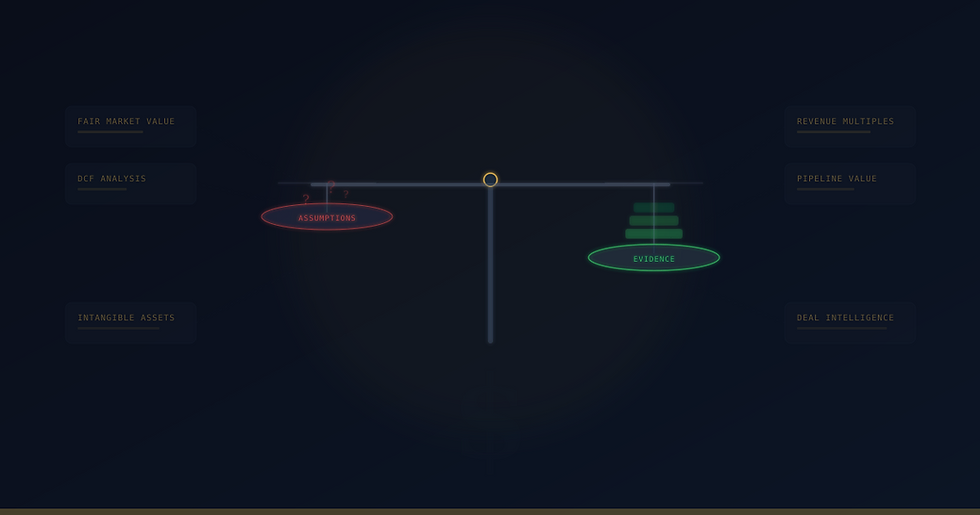
Presenting a BVA built on assumptions the prospect immediately challenges as inaccurate
How Spotlight.ai Automates BVA Generation
Spotlight.ai's Value Consultants Agent guides discovery to surface the specific data points needed for a prospect-specific BVA, then automatically generates the document from the discovery data captured.
Adaptive discovery guidance: surfaces the specific prospect data needed for accurate BVA inputs
Automated BVA generation: produces a customized, branded BVA from captured discovery data
Multiple ROI scenarios: generates conservative, expected, and aggressive impact models
Champion arming: produces BVA in a format champions can present internally without rep support

FAQs About Business Value Assessments
When should a BVA be introduced in the sales process?
A preliminary value hypothesis should be introduced early in discovery to create financial urgency. A full BVA should be developed after discovery is complete and refined with Economic Buyer input before the formal business case stage.
Who should own the BVA in an enterprise sales team?
In organizations with value engineering teams, the BVA is typically a joint effort between the account executive and the value engineer. In teams without a dedicated value function, AI tools like Spotlight.ai can produce a high-quality BVA from discovery data without dedicated headcount.
How specific does a BVA need to be to be credible?
At minimum, a credible BVA uses the prospect's actual industry, headcount, and performance data rather than generic benchmarks. The strongest BVAs use the prospect's own numbers — provided in discovery — to build the projection.
What is the difference between a BVA and a business case?
A BVA is the financial analysis component of a business case. A full business case typically includes the BVA alongside a solution overview, implementation timeline, risk assessment, and references.
How does AI improve BVA accuracy compared to manually built assessments?
AI-generated BVAs built from structured discovery data reduce the reliance on rep interpretation and recall, which are the primary sources of inaccuracy in manually built assessments.


Comments